
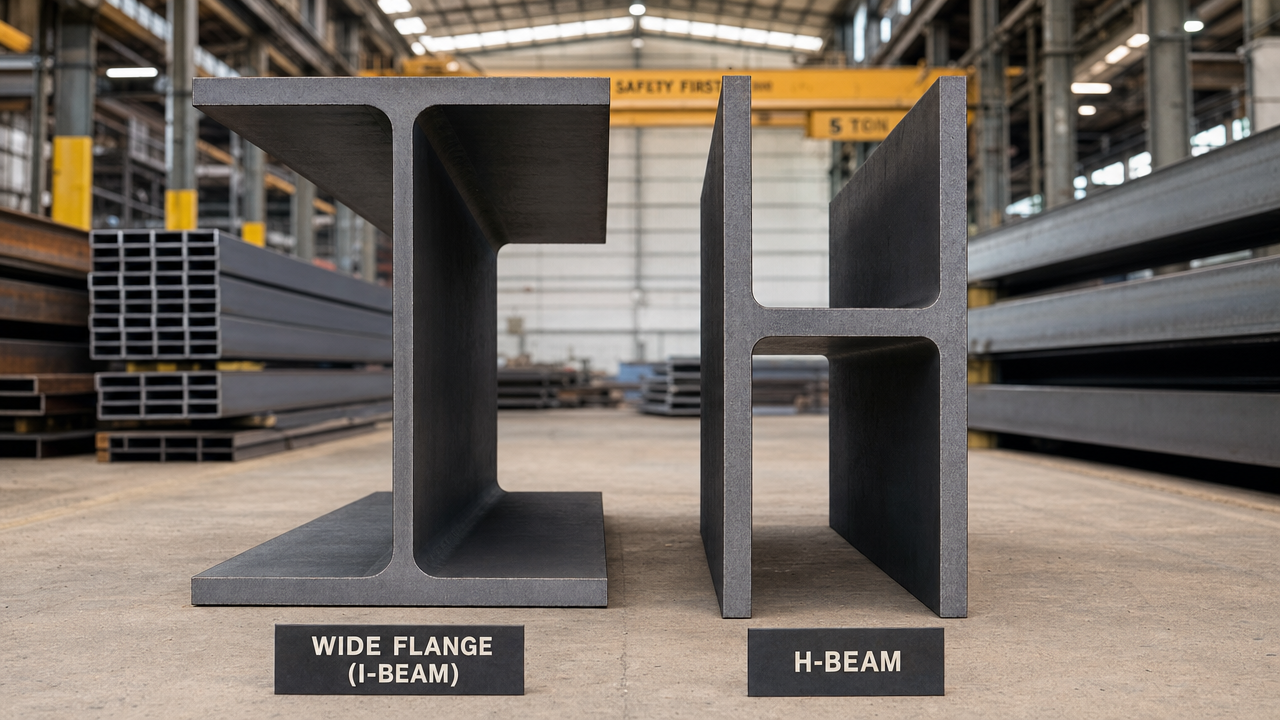
On site, the terms WF and H-Beam are often used interchangeably — but they are different profiles. Choosing the wrong one means an over-budget structure, or worse: an under-strength one. Here is the practical difference.
Key differences
| Aspect | WF (Wide Flange) | H-Beam |
|---|---|---|
| Proportions | Depth ≈ 2× flange width (e.g. 300 × 150) | Depth ≈ flange width (e.g. 300 × 300) |
| Cross-section | Resembles the letter I | Resembles the letter H |
| Weight | Lighter for a given depth | Heavier, stockier |
| Strength | Optimised for bending in one axis | Strong in all directions |
When to use WF
WF profiles are efficient as beams and girders — members that carry bending loads. The tall, slim shape delivers a large moment of inertia for minimal weight, making it economical for long spans such as warehouse roof framing and floor beams.
When to use H-Beam
H-Beams excel as columns — members that carry compression from all directions. The wide flanges make the profile stable against buckling on both axes. H-Beams are also common for piling and bridge structures.
Weight comparison example
- WF 300 × 150: 36.7 kg/m → 440 kg per 12 m bar
- H-Beam 300 × 300: 93.0 kg/m → 1,116 kg per 12 m bar
At the same depth, an H-Beam can weigh 2–3 times more. That is why the WF vs H-Beam decision has a major impact on your material budget.
Practical summary
- Beams / bending spans → WF
- Columns / axial loads → H-Beam
- Always follow your structural engineer’s calculations — this is only a starting guide.
See our full WF and H-Beam specification tables, or discuss your project with us — the Marselus Steel team has been helping builders since 1996.